

Why Does Entity Relevance Matter for Modern SEO Growth?
Sep 21, 2026
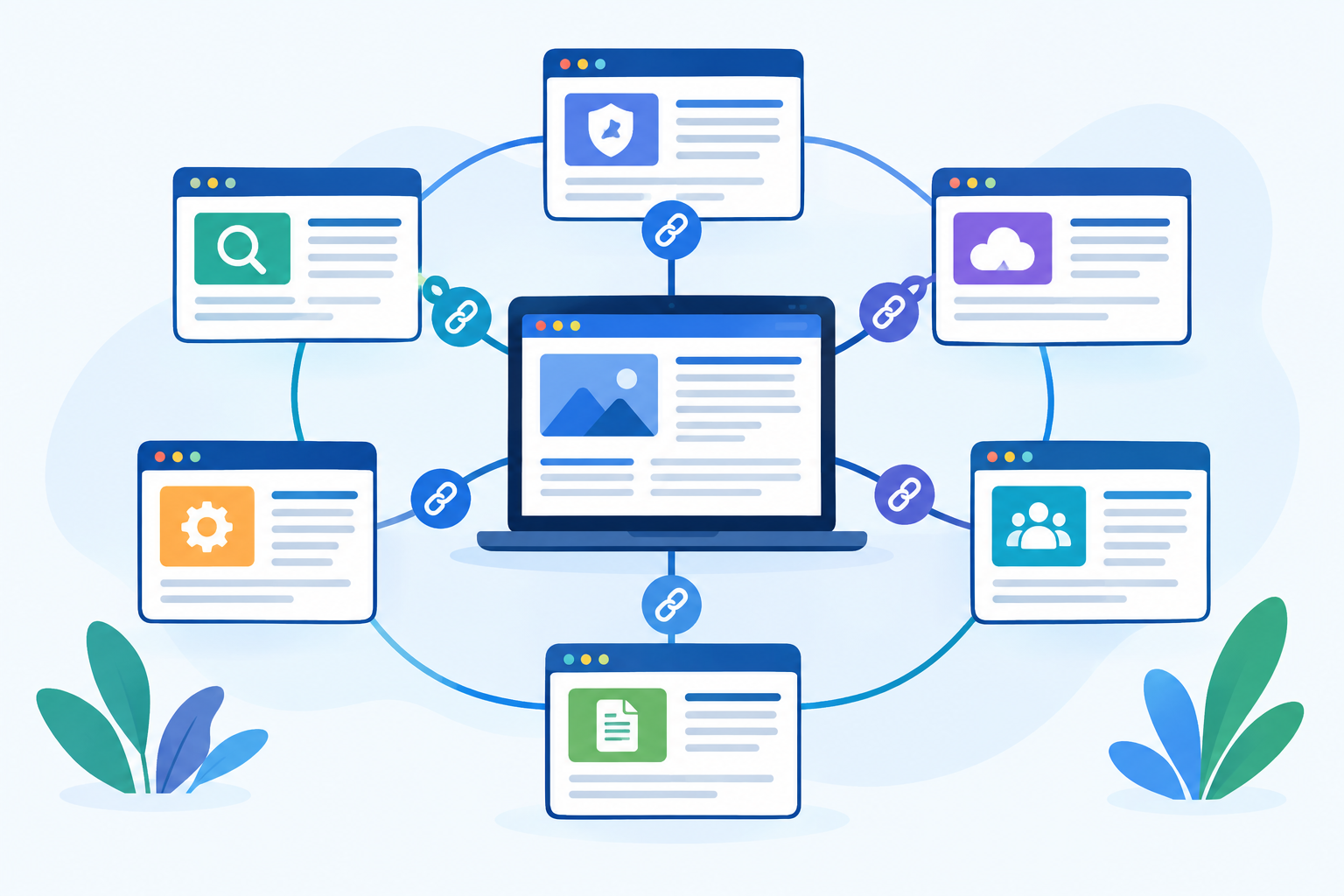
Modern SEO is no longer about creating separate pages for every keyword. Your audience rarely searches for information in isolation. One question often leads to another, and those questions are connected by topics, entities, problems, products, and user intent.
When you connect your content across related topics, you create a more useful information ecosystem. Instead of publishing disconnected articles, you build a website where each page supports another. This approach can improve content discovery, strengthen topical relevance, create better user journeys, and help search systems understand what your business knows.
Connecting related content means creating meaningful relationships between pages that address different but connected aspects of a broader subject.
For example, a cybersecurity company could publish content about:
These subjects are different, but they belong to the same broader knowledge area. Connecting them through contextual internal links and logical content architecture helps users move naturally from one question to the next.
The goal is not to add links simply because two pages contain similar keywords. Each connection should provide a useful next step for the reader. Semantic internal linking works best when the destination page adds context, answers a related question, or explores a supporting concept.
A single article can demonstrate expertise on one subject, but a connected group of useful pages can demonstrate broader coverage.
When you consistently address related questions, entities, subtopics, and user needs, your website develops a clearer topical structure. Semantic SEO focuses on meaning, context, relationships, and intent rather than treating keywords as isolated phrases.
For your business, this means you can move from targeting individual keywords to building a comprehensive resource around the subjects your customers actually care about.
Search systems need to interpret what your pages are about and how different pieces of information relate.
Consider a website selling accounting software. Content about invoicing, expense management, cash flow, bookkeeping, tax preparation, and financial reporting becomes more meaningful when those topics are connected logically.
Your internal links, headings, descriptive anchor text, and surrounding context can help communicate those relationships. However, linking alone does not create authority; the underlying content still needs to be relevant, useful, and differentiated.
Your visitors often need more than one answer before making a decision.
Someone searching for “how to improve website visibility” may later want to understand keyword research, content planning, technical SEO, semantic SEO, internal linking, and performance measurement.
If your website connects these subjects, users can continue learning without returning to search for every next question.
That creates a smoother journey from awareness → education → evaluation → action.
Internal links should have a purpose. Instead of using generic anchors such as “click here,” use descriptive language that tells readers what they will find.
For example, an SEO article could naturally link to a page about semantic SEO strategies for stronger topical relevance.
This makes the relationship between the pages clearer while giving users useful navigation paths. Recent semantic SEO guidance similarly emphasizes contextual links, distinct page responsibilities, descriptive anchors, and meaningful relationships between documents.
Start by selecting a broad business topic that matters to your customers. Then identify its major subtopics, questions, entities, and search intents.
Create a central pillar page for the broad subject and develop supporting pages for specific questions. Connect those pages wherever the relationship genuinely helps the reader.
You should also review existing content before creating new pages. You may already have valuable information that is isolated or poorly connected.
Next, audit your internal links. Ask:
This approach helps you build a connected content ecosystem rather than a collection of unrelated blog posts.
Building connected content requires more than publishing frequently. You need to understand search intent, topic relationships, semantic relevance, content gaps, and the role of every page within your website.
With SEO Climbers, you can approach SEO as a connected growth strategy rather than a collection of isolated keyword targets. The focus should be on creating useful content relationships that support your audience, strengthen your website structure, and create sustainable search visibility.
The strongest content strategy is not necessarily the one with the most pages. It is the one where the right pages work together.
Connecting related content creates a logical information structure that helps users discover relevant information and allows search systems to better understand relationships between topics, pages, and search intents.
Internal linking can support page discovery, navigation, contextual understanding, and website architecture. Its value is strongest when links connect genuinely related pages and provide useful context rather than being added only to increase link quantity.
Start with a core topic, identify related subtopics and user questions, assign a clear purpose to each page, and connect relevant pages using descriptive contextual anchors. Regularly review the structure for content gaps, duplication, and outdated relationships.
A well-organized content ecosystem can make information easier to interpret and retrieve because related concepts, entities, and relationships are clearly represented. However, no content structure guarantees inclusion in AI-generated answers.
There is no universal ideal number. Add links when they genuinely help users understand a related concept or continue their research. Relevance and context are more important than hitting an arbitrary link count.
Your content should not operate as a collection of isolated pages. When related topics are thoughtfully connected, your website can provide deeper answers, clearer navigation, stronger contextual signals, and a better overall search experience.