

Why Should Businesses Connect Content Across Related Topics?
Sep 28, 2026
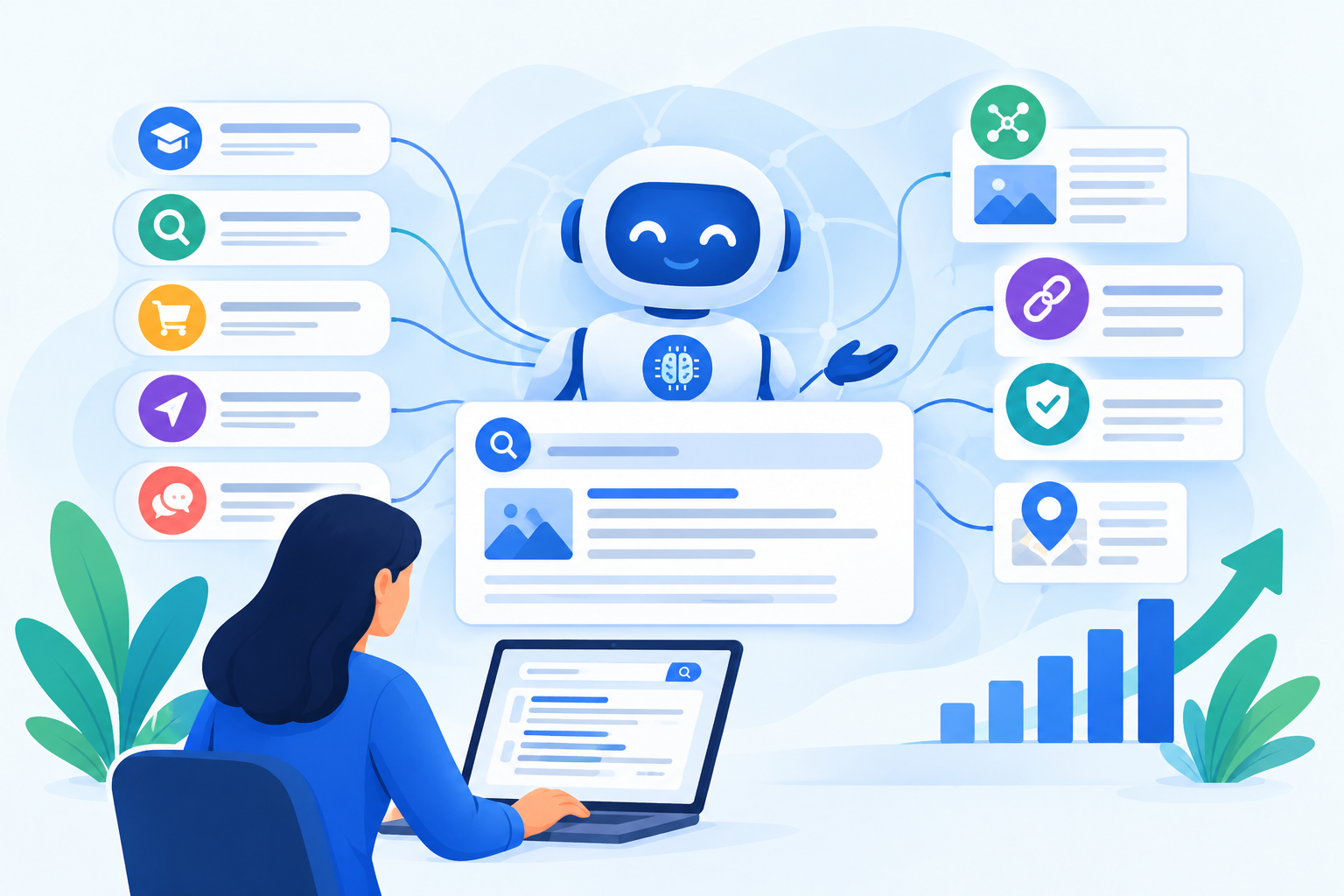
Search is changing from a list of links into an experience where artificial intelligence interprets questions, connects information, and generates direct answers. Google AI Overviews and AI Mode are increasingly designed to surface relevant websites and original information, while other AI platforms are also changing how people discover brands.
For your brand, this means traditional rankings are no longer the only visibility goal. You also need content that search engines and AI systems can understand, retrieve, evaluate, and confidently reference.
This is where SEO Climbers can help you build a stronger AI-search strategy.
AI search visibility is your brand’s ability to appear, be referenced, or become a source within AI-generated answers.
Instead of only asking, “Does my page rank for this keyword?” you should also ask:
Google’s guidance makes one point particularly clear: SEO remains important for generative AI search because AI features rely on existing Search systems and indexed web content.
AI search often handles conversational and complex queries rather than isolated keywords. Your content should therefore address the reason behind a search.
Start by identifying different levels of intent:
Instead of creating separate pages that target minor keyword variations, develop comprehensive resources that answer connected questions.
For example, a SaaS company could build a content ecosystem covering software selection, implementation, integrations, security, pricing considerations, use cases, and industry-specific applications.
This gives AI systems more context about the brand’s expertise.
AI systems need context, not just keyword repetition.
Your content should clearly connect your brand with relevant entities, topics, services, audiences, problems, and solutions.
For example, if you provide cybersecurity services, your website should establish meaningful relationships between cybersecurity, threat detection, ransomware protection, compliance, security monitoring, incident response, and the industries you serve.
Use internal links to connect related resources. Build topic clusters around important business areas. Maintain consistent terminology across your website.
A strong semantic structure makes your expertise easier to interpret while also creating a better experience for human readers.
Being visible in AI search requires more than producing large quantities of articles.
Focus on content that demonstrates:
Avoid writing primarily for algorithms. Google’s current guidance emphasizes crawlability, useful content, page experience, and established SEO fundamentals for generative AI features.
Your goal should be simple: create the resource that deserves to be referenced.
AI systems should not have to guess what your company does.
Clearly communicate your:
Keep these signals consistent across your website and relevant external platforms.
Structured data can also help search engines understand page information, although it should complement—not replace—strong content and technical SEO.
People increasingly ask AI systems complete questions rather than entering short keyword phrases.
Your content should reflect this behavior.
Instead of focusing only on a phrase such as “enterprise SEO,” address questions such as:
“How can enterprise brands improve organic visibility across AI search?”
Then provide a direct answer, followed by supporting details, examples, processes, and practical recommendations.
This structure helps you address long-tail searches and the related questions AI systems may explore when constructing an answer.
One article rarely establishes authority by itself.
With SEO Climbers, you can approach your website as a connected content ecosystem rather than a collection of individual blog posts.
Start with your most important business topics. Build pillar pages around them, then develop supporting articles covering subtopics, questions, use cases, comparisons, and industry applications.
Connect these pages through contextual internal links.
Over time, this creates stronger topical relationships and gives search engines more information about the depth of your expertise.
AI visibility should be measured instead of treated as an assumption.
Track traditional SEO metrics alongside indicators such as:
Google has introduced a Generative AI performance report in Search Console that provides insights into impressions from generative AI features, including pages receiving impressions and geographic information.
This allows you to move beyond rankings and understand how your content performs within emerging search experiences.
AI search visibility is not achieved through one technical trick or a single optimization.
It requires a coordinated strategy connecting technical SEO, semantic relevance, topical authority, search intent, high-quality content, brand entities, internal linking, and measurable performance.
By applying these principles consistently, you can make your website easier for both people and AI systems to understand.
If you want to develop a stronger search and AI visibility strategy, Contact us today to discuss how SEO Climbers can support your growth.
What is AI search visibility?
AI search visibility is the ability of your brand, website, or content to appear, be referenced, or be cited within AI-generated search answers.
Is traditional SEO still important for AI search?
Yes. Google states that its generative AI search features rely on core Search ranking and quality systems, making strong SEO fundamentals important for AI visibility.
How can SEO Climbers improve AI search visibility?
SEO Climbers can help you develop a strategy based on search intent, semantic SEO, topical authority, entity relationships, content ecosystems, technical SEO, and performance measurement.
Does publishing more content guarantee AI visibility?
No. Content quality, relevance, expertise, crawlability, topical depth, and usefulness matter more than simply increasing publishing volume.
How should brands measure AI search visibility?
Combine conventional SEO metrics with AI-search impressions, brand mentions, citations, referenced pages, relevant queries, and business conversions.